


 PVD Coating
Introduction to Surface Friction in CNC Machining
How Surface Friction Impacts Tool Performance in CNC Operations is a critical subject in modern manufacturing environments where precision, productivity, and durability dictate operational success. In CNC machining, friction occurs when the cutting tool comes into direct contact with the workpiece material under intense pressure and velocity. This interaction creates resistance that affects nearly every aspect of machining performance.
Even microscopic frictional inconsistencies can trigger significant thermal stress, dimensional inaccuracies, and premature tool degradation. Manufacturers striving for superior machining stability must understand how friction behaves during high-speed cutting applications. Efficient friction management not only enhances cutting consistency but also extends equipment longevity while reducing operational expenditure.
Understanding the Relationship Between Friction and Tool Performance
Surface friction directly influences cutting efficiency. As friction increases, the cutting tool experiences higher resistance against the material being machined. This elevated resistance forces the spindle and tooling system to exert additional energy during material removal.
The consequences are multifaceted. Increased friction elevates cutting temperatures, accelerates abrasive wear, and diminishes edge sharpness. Over time, the tool loses its structural integrity and machining precision deteriorates.
Conversely, optimized friction conditions allow tools to glide smoothly through the material. This improves chip evacuation, reduces mechanical strain, and stabilizes cutting dynamics. The result is a cleaner surface finish, improved dimensional tolerance, and enhanced operational continuity.
How Heat Generation Accelerates Tool Wear
Friction and heat are inseparable in CNC machining. As the cutting interface experiences resistance, thermal energy accumulates rapidly around the tool edge. Excessive heat weakens the metallurgical properties of the tool material, especially during prolonged machining cycles.
Thermal concentration can lead to:
- Oxidation wear
- Diffusion wear
- Plastic deformation
- Thermal cracking
- Edge chipping
These failures dramatically shorten tool lifespan. Heat accumulation also compromises the workpiece surface by creating discoloration, residual stress, and microstructural distortion.
Using a heat-resistant coating for machining tools can substantially reduce thermal stress while preserving cutting-edge sharpness under extreme machining conditions.
The Influence of Friction on Cutting Accuracy
Precision machining depends heavily on stable cutting conditions. Elevated surface friction disrupts tool movement and introduces vibration into the machining process. Even minute vibrations can produce dimensional deviations and inconsistent surface finishes.
In high-tolerance industries such as aerospace, automotive, and medical manufacturing, friction-induced inaccuracies can result in rejected components and costly production delays.
Stable low-friction cutting environments improve:
- Positional accuracy
- Surface integrity
- Edge consistency
- Repeatability
- Geometric precision
This is why manufacturers increasingly invest in low-friction surface coating technologies for demanding CNC applications.
Material Adhesion and Built-Up Edge Formation
One of the most common consequences of excessive friction is built-up edge formation. This phenomenon occurs when fragments of the workpiece material adhere to the cutting edge of the tool.
As layers accumulate, the cutting geometry changes unpredictably. The tool begins cutting inefficiently, leading to rough surfaces, erratic chip formation, and inconsistent machining behavior.
Built-up edge formation is especially prevalent when machining ductile metals such as aluminum and stainless steel. Reduced friction levels help minimize adhesion and maintain uninterrupted cutting stability.
Effects of Surface Friction on Machining Speed and Productivity
Higher friction often forces operators to reduce cutting speeds to avoid catastrophic tool failure. While this may temporarily protect tooling, it substantially decreases productivity and throughput.
Low-friction machining environments support:
- Faster spindle speeds
- Higher feed rates
- Reduced downtime
- Improved cycle efficiency
- Longer uninterrupted production runs
Manufacturers seeking competitive operational efficiency increasingly prioritize friction optimization as part of broader machining performance strategies.
Importance of Lubrication in CNC Operations
Lubrication acts as a protective intermediary between the tool and workpiece surfaces. Proper lubrication minimizes direct metal-to-metal contact and dissipates heat more effectively.
Modern machining operations utilize various lubrication techniques, including:
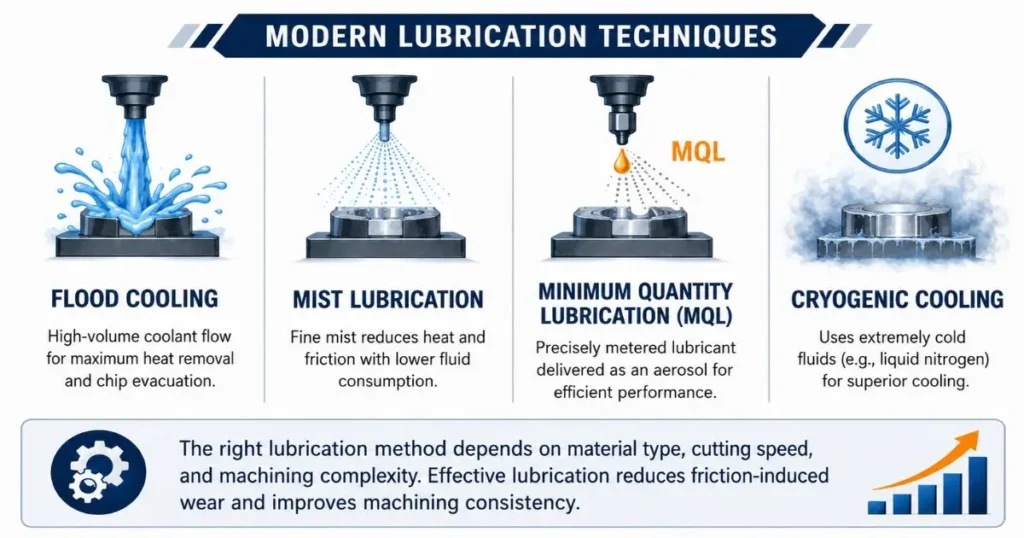
- Flood cooling
- Mist lubrication
- Minimum quantity lubrication (MQL)
- Cryogenic cooling
Selecting the correct lubrication method depends on material type, cutting speed, and machining complexity. Effective lubrication significantly reduces friction-induced wear and enhances machining consistency.
Role of Tool Materials in Reducing Friction
Tool substrate materials greatly influence friction behavior. Carbide, ceramic, cubic boron nitride, and polycrystalline diamond tools each exhibit distinct tribological characteristics.
Advanced tool materials provide:
- Higher hardness
- Superior heat resistance
- Reduced adhesion tendencies
- Enhanced wear resistance
The correct combination of substrate and coating can dramatically improve machining stability in abrasive or high-temperature environments.
Why Coatings Matter in Modern CNC Machining
Tool coatings serve as protective barriers against friction, heat, and wear. These coatings enhance surface hardness while reducing chemical interaction between the tool and workpiece.
Modern coatings improve:
- Tool longevity
- Chip flow dynamics
- Surface finish quality
- Thermal resistance
- Oxidation protection
The effectiveness of coatings depends heavily on deposition quality and coating composition. Many manufacturers now rely on the physical vapor deposition process to create ultra-thin, high-performance coatings with exceptional adhesion properties.
Surface Engineering Technologies Transforming Tool Performance
The evolution of advanced surface engineering technology has significantly transformed CNC machining efficiency. Modern surface treatments are designed to optimize tribological behavior at microscopic levels.
Advanced engineering methods improve:
- Surface smoothness
- Hardness uniformity
- Thermal stability
- Corrosion resistance
- Friction reduction
Nanostructured coatings and multilayer deposition systems now allow tooling manufacturers to engineer highly specialized surfaces for extreme machining applications.
Comparing Different Industrial Surface Coating Solutions
An effective industrial surface coating comparison reveals that not all coatings perform equally under identical machining conditions.
Some coatings prioritize thermal resistance, while others focus on hardness or lubricity. Common coating options include:
- Titanium Nitride (TiN)
- Titanium Aluminum Nitride (TiAlN)
- Chromium Nitride (CrN)
- Diamond-Like Carbon (DLC)
- Aluminum Titanium Nitride (AlTiN)
Each coating type offers unique advantages depending on the machining material and operational environment. Selecting the proper coating is essential for maximizing machining efficiency and reducing operational costs.
Best Practices to Minimize Friction in CNC Operations
Reducing friction requires a comprehensive machining strategy. Manufacturers should focus on process optimization rather than isolated adjustments.
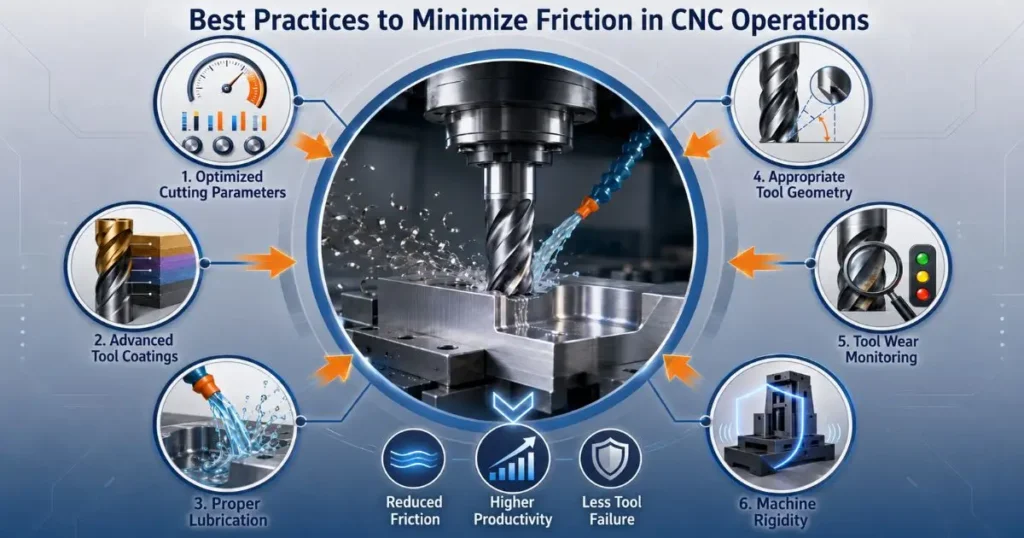
Key best practices include:
- Using optimized cutting parameters
- Selecting appropriate tool geometry
- Applying advanced coatings
- Maintaining proper lubrication
- Monitoring tool wear regularly
- Ensuring machine rigidity
A proactive friction management strategy improves productivity while minimizing unexpected tool failure.
Common Signs of Excessive Friction in CNC Machining
Operators should recognize the early indicators of excessive friction before severe tooling damage occurs.
Common warning signs include:
- Unusual cutting noise
- Increased vibration
- Poor surface finish
- Burn marks on workpieces
- Rapid tool wear
- Irregular chip formation
Early intervention helps prevent production interruptions and expensive machine downtime.
Future Trends in Friction Reduction Technologies
The future of CNC machining is increasingly focused on intelligent friction control systems and advanced material science.
Emerging innovations include:
- Self-lubricating coatings
- Nano-composite surface layers
- AI-driven machining optimization
- Smart tool condition monitoring
- Hybrid surface engineering techniques
These advancements are expected to redefine machining performance standards across multiple industrial sectors.
Conclusion
Understanding How Surface Friction Impacts Tool Performance in CNC Operations is essential for manufacturers seeking higher productivity, superior precision, and extended tool life. Friction affects every stage of the machining process, from heat generation and tool wear to dimensional accuracy and operational efficiency.
By integrating advanced coatings, optimized lubrication systems, and modern surface engineering technologies, manufacturers can dramatically reduce friction-related failures and improve machining reliability. As CNC machining continues to evolve, friction management will remain a pivotal factor in achieving sustainable manufacturing excellence.
FAQs
Surface friction directly affects heat generation, tool wear, cutting precision, and machining efficiency. Managing friction improves overall machining performance and tool lifespan.
Tool coatings create protective low-friction surfaces that reduce heat buildup, improve chip flow, and minimize material adhesion during machining.
Built-up edge formation occurs when excessive friction causes workpiece material to stick to the cutting tool edge, altering cutting geometry and reducing machining quality.
Coatings such as TiAlN and AlTiN are commonly preferred for high-temperature machining due to their superior thermal resistance and oxidation protection.
Manufacturers can improve metal cutting performance optimization by using advanced coatings, proper lubrication systems, optimized cutting parameters, and high-quality tooling solutions.
Looking to improve CNC tool performance with advanced coating solutions and precision surface engineering technologies? Explore innovative machining solutions designed to reduce friction, extend tool life, and maximize manufacturing efficiency.
Comments are closed